Target Dry Density – 600 to 1200 Kg/m³
- Filling Unwanted Voids and Sunken Areas
- The Challenge: Traditional methods of filling underground voids, abandoned pipes, or sunken landscape areas are labor-intensive and risky. Heavy, granular materials can settle unevenly or exert excessive pressure on surrounding structures, leading to future subsidence.
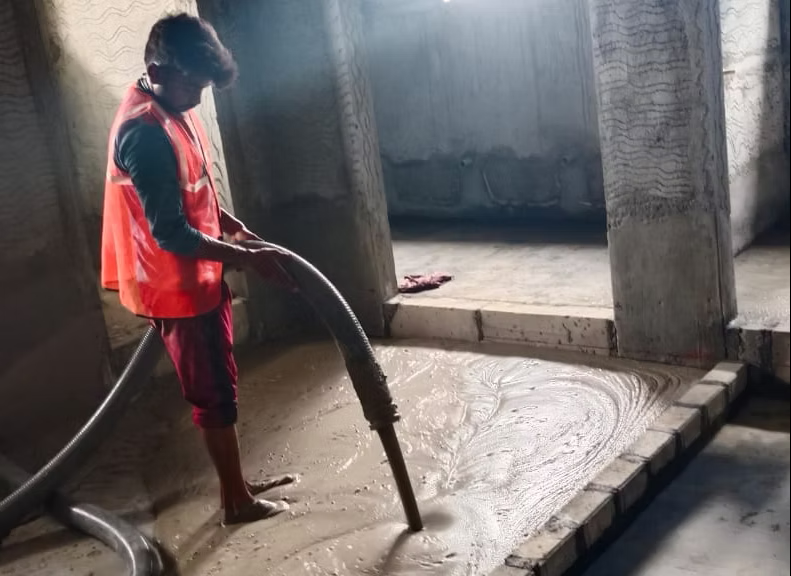
- The NLAC Solution: Due to its ultra-lightweight nature and self-leveling fluidity, NLAC can be pumped over long distances to fill complex, inaccessible voids completely and uniformly. It flows into every crevice without segregation, creating a monolithic, stable fill that prevents future collapse. Its minimal weight ensures it does not overload the void’s roof or walls, making the process far safer and more effective.
- Stabilization for Bridge Abutments and Embankments
- The Challenge: The ground behind bridge abutments and beneath approach slabs is prone to settling over time. This creates a “bump” at the end of the bridge—a common and hazardous problem known as the bridge-end slap. This settlement is often caused by the immense pressure and inadequate compaction of backfill materials.
- The NLAC Solution: Using NLAC as a lightweight backfill material dramatically reduces the lateral earth pressure on the bridge abutment. This prevents movement and settlement, effectively eliminating the bridge-end slap. Its flowability ensures perfect contact with the abutment wall without mechanical compaction, leading to a longer-lasting, smoother, and safer bridge transition.
- Tunneling and Underground Works
- The Challenge: In tunnel construction, there are often gaps between the tunnel lining and the surrounding soil (over-excavation). These voids can lead to stress concentrations, ground settlement, and potential structural failure if not properly filled.
- The NLAC Solution: NLAC is the perfect material for annulus grouting and backfilling in tunneling. It can be pumped behind the tunnel linings to fill every void, transferring ground loads uniformly around the structure. Its lightweight nature minimizes the load on the tunnel lining itself, while its thermal insulation properties can also be a beneficial side-effect in certain applications.
- Landslide Mitigation and Slope Stabilization
- The Challenge: Stabilizing unstable slopes and landslide-prone areas often requires reducing the driving forces that cause the slide. Using heavy materials for buttresses or retaining structures can sometimes exacerbate the problem by adding more weight to the unstable mass.
- The NLAC Solution: NLAC can be used to construct lightweight retaining structures, gravity walls, or to fill behind stabilizing structures. By significantly reducing the mass placed on the slope, NLAC helps re-establish equilibrium without adding detrimental weight. This provides a stable, durable solution that works in harmony with the geology rather than against it.
- Remediation of Old Mine Workings and Sinkholes
- The Challenge: Abandoned mines and emerging sinkholes pose a severe risk of catastrophic collapse. Filling them with traditional materials is often prohibitively expensive and logistically challenging, as the weak strata may not support the weight of a conventional concrete fill.
The NLAC Solution: NLAC’s low density makes it the only feasible choice for the large-scale infilling of old mines and sinkholes. It can be produced on-site and pumped vast distances into mine shafts and cavities. It stabilizes the area by providing a firm, yet lightweight, fill that bridges across weak zones and prevents further subsidence, thereby safeguarding future development above these areas.